Click here to view entire ordinance
SALT LAKE CITY ORDINANCE
No. 20 of 2014
(An ordinance amending certain land use provisions of
Title 21A (Zoning) of the Salt Lake City Code)
An ordinance amending certain sections of Title 21A (Zoning) of the Salt Lake City Code pursuant to Petition No. PLNPCM2013-00291 to provide additional clarity and efficiency in land use regulation.
WHEREAS, the Salt Lake City Planning Commission held a public hearing on February 26, 2014 to consider a request made by Salt Lake City Mayor Ralph Becker (Petition No. PLNPCM2013-00291) to amend the text of Sections 21A.40.120 (Zoning: Accessory Uses, Buildings and Structures: Regulations of Fences, Walls and Hedges); 21A.48.100 (Zoning: Landscaping and Buffers: Special Landscape Regulations); 21A.52.030 (Zoning: Special Exceptions: Special Exceptions Authorized); 21A.62.040 (Zoning: Definitions: Definitions of Terms); 21A.62.050 (Zoning: Definitions: Illustrations of Selected Definitions); 21A.24.170 (Zoning: Residential Districts: R-MU Residential/Mixed use District); 21A.26.078 (Zoning: Commercial Districts: Transit Station Area District); and 21A.48.060 (Zoning: Landscaping and Buffers: Park Strip Landscaping) of the Salt Lake City Code to provide further clarity and efficiency in land use regulation; and
WHEREAS, at its February 26, 2014 hearing, the planning commission voted in favor of recommending to the Salt Lake City Council that the city council amend the sections of Title 21A of the Salt Lake City Code identified herein; and
WHEREAS, after a public hearing on this matter the city council has determined that adopting this ordinance is in the city’s best interests,
NOW, THEREFORE, be it ordained by the City Council of Salt Lake City, Utah:
PART I. – FENCE HEIGHT IN NON-RESIDENTIAL DISTRICTS
SECTION 1. Amending text of Salt Lake City Code Section 21A.40.120.E. That Section 21A.40.120.E of the Salt Lake City Code (Zoning: Accessory Uses, Buildings and Structures: Regulations of Fences, Walls and Hedges: Height Restrictions), shall be, and hereby is, amended to read as follows:
E. Height Restrictions and Gates:
1. General Height:
a. Residential Zoning Districts: except for the Special Foothills Regulations as outlined in Chapter 21A.24.010.P, no fence, wall or hedge shall be erected to a height in excess of four feet (4') between the front property line and front building line of the facade of the principal structure that contains the primary entrance.
b. Non-residential Zoning Districts: no fence, wall or hedge shall be erected to a height in excess of four feet (4') when within any required front yard area. Fencing for outdoor storage shall be located behind any required front yard area.
2. Corner Lots; Sight Distance Triangle: No solid fence, wall or hedge shall be erected to a height in excess of three feet (3') if the fence, wall or hedge is located within the sight distance triangle extending thirty feet (30') either side of the intersection of the respective street curb lines, or edge lines of roadway where curbing is not provided as noted in Section 21A.62.050, illustration I of this title.
3. Corner Side, Side, Rear Yards; Sight Distance Triangle: Fences, walls or hedges may be erected in any required corner side yard (extending to a point in line with the front facade of the principal structure for residential zoning districts and up to any required front yard setback line for all other zoning districts), required side yard or required rear yard to a height not to exceed six feet (6'). The zoning administrator may require either increased fence setback or lower fence height along corner side yards to provide adequate line of sight for driveways and alleys.
4. Intersection
of Driveway; Sight Distance Triangle: Solid fences, walls and hedges
shall not exceed thirty inches (30") in height within the sight distance
triangle as defined in Section 21A.62.050, illustration I of this
title.
5. Sight Distance Triangle and See Through Fences: Within the area defined as a sight distance triangle, see through fences that are at least fifty percent (50%) open shall be allowed to a height of four feet (4').
6. Alternative Design Solutions: To provide adequate line of sight for driveways and alleys, the zoning administrator, in consulting with the development review team, may require alternative design solutions, including, but not restricted to, requiring increased fence setback and/or lower fence height, to mitigate safety concerns created by the location of buildings, grade change or other preexisting conditions.
7. Measuring: Measuring the height of a fence shall be from the "finished grade" of the site as defined in Section 21A.62.040 of this title.
8. Special Exception Approval Standards: The planning commission or historic landmark commission may approve taller fencing if it is found that the extra height is necessary for the security of the property in question as defined in Chapter 21A.52 of this title.
9. Gates: no gate, whether crossing a driveway, walkway, or part of a fence, shall be erected to a height in excess of the standards outlined in this paragraph E Height Restrictions and Gates. To regulate the location of gates and their impact on vehicular staging within the public right-of-way, passenger vehicles shall require a minimum seventeen foot six inch (17’- 6”) setback from back edge of sidewalk, or property line when a sidewalk is not provided, and large truck driveways shall require a one hundred foot (100') setback from back edge of sidewalk, or property line when a sidewalk is not provided. All gates are to swing inward to the property or be a roll gate that does not impact the staging area.
SECTION 2. Amending text of Salt Lake City Code Section 21A.48.100.D.2.a. That Section 21A.48.100.D.2.a of the Salt Lake City Code (Zoning: Landscaping and Buffers: Special Landscape Regulations: D-1 Central Business District and D-4 Downtown Secondary Central Business District: Landscaping for Vacant Lots), shall be, and hereby is amended to read as follows:
a. Landscape Yard Requirement: A landscape yard of fifteen feet (15') shall be required as measured from any point along all property lines. Fencing, pursuant to section 21A.40.120 of this title, can be used as an element of the overall landscaping plan, however, shall not be used in lieu of the landscaping requirements of this section. The purpose of any fencing on downtown lots is for aesthetic value only, and shall consist of wrought iron or other similar material (no chainlink). Fencing shall be open so as not to create a visual barrier, and shall be limited to a maximum of four feet (4') in height, with the exception of a fence located on any corner lot as noted in subsection 21A.40.120.E of this title. The approval of a final landscape plan, that includes a fencing element, shall be delegated to the building official with the input of the planning director, to determine if the fencing materials, location, and height are compatible with adjacent properties in a given setting.
SECTION 3. Amending text of Salt Lake City Code Section 21A.52.030.A.3.b. That Section 21A.52.030.A.3.b of the Salt Lake City Code (Zoning: Special Exceptions: Special Exceptions Authorized), shall be, and hereby is amended to read as follows:
b. Exceeding the allowable height limits on any corner lot; unless the city's traffic engineer determines that permitting the additional height would cause an unsafe traffic condition;
SECTION 4. Amending text of Salt Lake City Code Section 21A.62.040. That Section 21A.62.040 of the Salt Lake City Code (Zoning: Definitions: Definitions of Terms) shall be, and hereby is amended only to modify the definition of “SIGHT DISTANCE TRIANGLE”. The codifier is instructed to modify this section only as it pertains to the definition of “SIGHT DISTANCE TRIANGLE” and make no other revisions to that section with respect to this ordinance. The revised definition of “SIGHT DISTANCE TRIANGLE” shall read as follows:
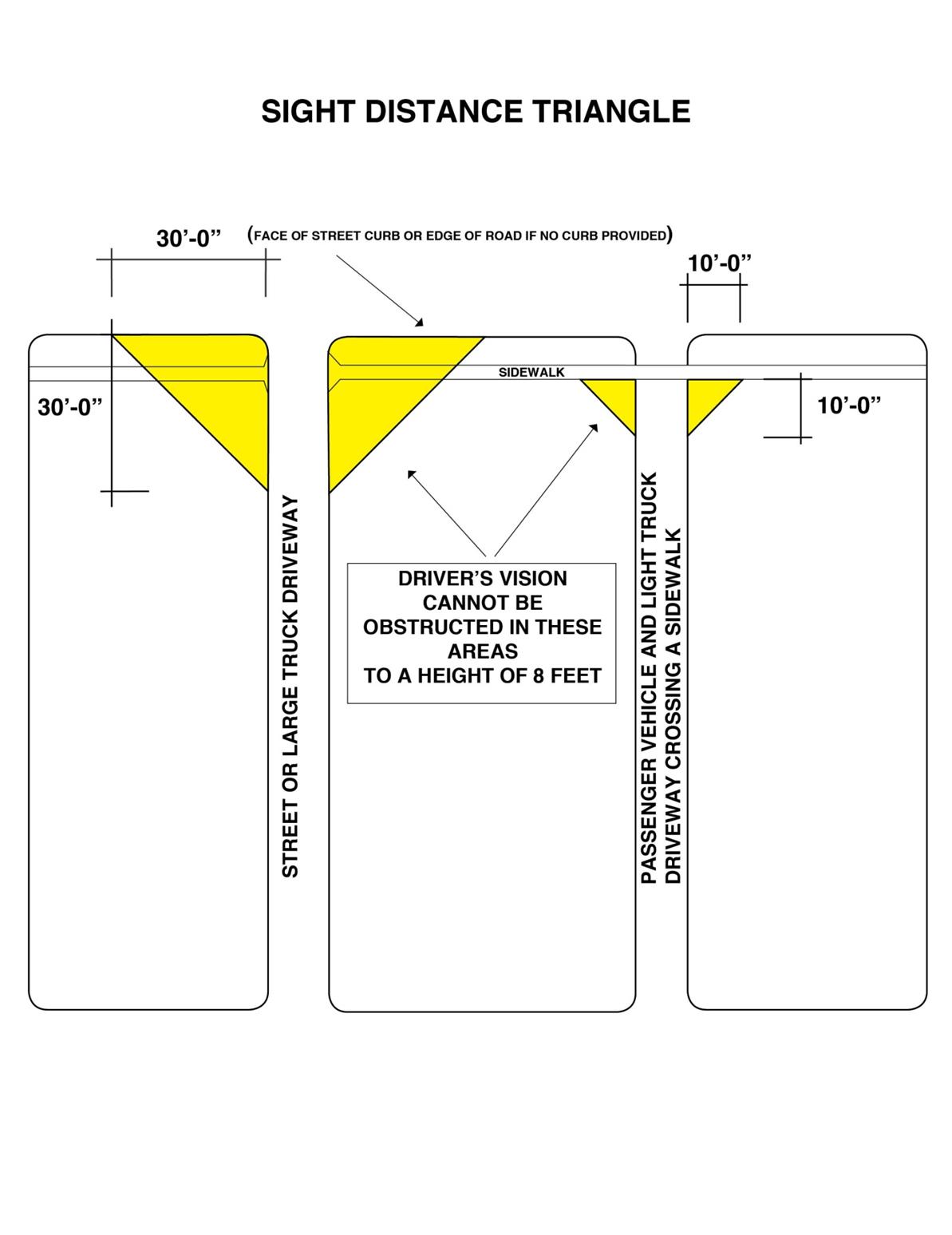
SIGHT DISTANCE TRIANGLE: A triangular area formed by a diagonal line connecting two (2) points when measured as follows:
a) For Corner Lots: extending thirty feet (30’) from the intersecting line of each street face of curb, or edge of roadway where curbing is not provided. Proposals in commercial and industrial districts which have a minimum front or corner side yard setback requirement, that seem to allow encroachment into the sight distance triangle, shall be reviewed through the site plan review process by the city’s Development Review Team.
b) For Street or Large Truck Driveways: extending thirty feet (30’) from each intersecting edge of the driveway and street face of curb, or edge of roadway where curbing is not provided.
c) For Passenger Vehicle and Light Truck Driveways Crossing a Sidewalk: extending ten feet (10’) from each intersecting edge of the driveway and back edge of the sidewalk.
The purpose of the sight distance triangle is to define an area in which vision obstructions are prohibited. (See illustration in Section 21A.62.050 of this chapter.)
SECTION 5. Amending text of Salt Lake City Code Section 21A.62.050.I. That Section 21A.62.050.I of the Salt Lake City Code (Zoning: Definitions: Illustrations of Selected Definitions: Sight Distance Triangle) shall be, and hereby is amended to replace the existing Illustration “I” with the following new Illustration “I”:
PART II. – R-MU DISTRICT MINIMUM YARD REQUIREMENTS
SECTION 6. Amending text of Salt Lake City Code Section 21A.24.170.E.6. That Section 21A.24.170.E.6 of the Salt Lake City Code (Zoning: Residential Districts: R-MU Residential/Mixed use District: Minimum Yard Requirements: Minimum Lot Area Exemptions), shall be, and hereby is amended to read as follows:
6. Minimum Lot Area Exemptions: For multiple-unit residential uses, nonresidential and mixed uses, no minimum lot area is required. In addition, no front, corner side or interior side yards or landscaped setbacks are required; except where interior side yards are provided, they shall not be less than four feet (4').
PART III. – TSA DISTRICT SIDE AND REAR YARD SETBACK
SECTION 7. Amending text of Salt Lake City Code Section 21A.26.078.G.2.b.(2)(B). That Section 21A.26.078.G.2.b.(2)(B) of the Salt Lake City Code (Zoning: Commercial Districts: Transit Station Area District: Development Standards: Application: Setbacks), shall be, and hereby is amended to read as follows:
(B) Side yard setback when adjacent to certain zoning districts:
(i) Core area: A minimum of twenty five feet (25') when adjacent to an OS, R-1, R-2, SR, RMF-30, RMF-35 or RMF-45 zoning district. The minimum side yard setback shall be increased one foot (1') for every one foot (1') increase in height above twenty five feet (25'). When a property in an OS, R-1, R-2, SR, RMF-30, RMF-35 or RMF-45 zoning district is separated from a TSA zoned property by an alley, the additional setback for height above twenty five feet (25') applies and shall be measured from the property line of the TSA zoned property. Buildings may be stepped so taller portions of a building are farther away from the rear property line. The horizontal measurement of the step shall be equal to the vertical measurement of the taller portion of the building.
(ii) Transition area: A minimum of twenty five feet (25') when adjacent to an OS, R-1, R-2, SR, RMF-30, RMF-35 or RMF-45 zoning district. The minimum rear yard setback shall be increased one foot (1') for every one foot (1') increase in height above twenty five feet (25'). When a property in an OS, R-1, R-2, SR, RMF-30 or RMF-35 zoning district is separated from a TSA zoned property by an alley, the additional setback for height above twenty five feet (25') applies and shall be measured from the property line of the TSA zoned property. Buildings may be stepped so taller portions of a building are farther away from the rear property line. The horizontal measurement of the step shall be equal to the vertical measurement of the taller portion of the building.
(iii) Side Yard Setback when Adjacent to all other Districts: No minimum side yard required.
SECTION 8. Amending text of Salt Lake City Code Section 21A.26.078.G.2.b.(3). That Section 21A.26.078.G.2.b.(3) of the Salt Lake City Code (Zoning: Commercial Districts: Transit Station Area District: Development Standards: Application: Setbacks: Rear Yard Setback), shall be, and hereby is amended to read as follows:
(3) Rear Yard Setback:
(A) Rear yard setback when adjacent to certain zoning districts:
(i) Core area: A minimum of twenty five feet (25') when adjacent to an OS, R-1, R-2, SR, RMF-30, RMF-35 or RMF-45 zoning district. The minimum rear yard setback shall be increased one foot (1') for every one foot (1') increase in height above twenty five feet (25'). When a property in an OS, R-1, R-2, SR, RMF-30, RMF-35 or RMF-45 zoning district is separated from a TSA zoned property by an alley, the additional setback for height above twenty five feet (25') applies and shall be measured from the property line of the TSA zoned property. Buildings may be stepped so taller portions of a building are farther away from the rear property line. The horizontal measurement of the step shall be equal to the vertical measurement of the taller portion of the building.
(ii) Transition area: A minimum of twenty five feet (25') when adjacent to an OS, R-1, R-2, SR, RMF-30, RMF-35 or RMF-45 zoning district. The minimum rear yard setback shall be increased one foot (1') for every one foot (1') increase in height above twenty five feet (25'). When a property in an OS, R-1, R-2, SR, RMF-30 or RMF-35 zoning district is separated from a TSA zoned property by an alley, the additional setback for height above twenty five feet (25') applies and shall be measured from the property line of the TSA zoned property. Buildings may be stepped so taller portions of a building are farther away from the rear property line. The horizontal measurement of the step shall be equal to the vertical measurement of the taller portion of the building.
(iii) Rear Yard Setback when Adjacent to all other Districts: No minimum rear yard required.
PART IV. – PARK STRIP LANDSCAPING AND BUS STOP BENCHES / SHELTERS
SECTION 9. Amending text of Salt Lake City Code Section 21A.48.060.E.8 That Section 21A.48.060.E.8 of the Salt Lake City Code (Zoning: Landscaping and Buffers: Park Strip Landscaping: Park Strip Ground Surface Treatment), shall be, and hereby is amended to read as follows:
8. Exceptions to Park Strip Standards: Exceptions to the park strip policies established herein shall be limited to the following:
a. Beautification District: Salt Lake City currently has two (2) approved beautification districts, one located downtown and one in the Sugar House business district area. In both beautification districts, materials other than vegetation have been approved. Additional beautification districts could be approved by the planning commission. Areas where alternative park strip materials could be considered include identifiable nonresidential areas. The beautification district concept is not intended to respond to one or two (2) properties but an identifiable district. The beautification district concept is not generally applicable to residential areas where a predominant design theme consisting of vegetation has been established.
b. Nonconforming Provision: All vegetation located in park strips prior to November 5, 1992, may be maintained subject to city transportation division approval for sight distance and public way safety requirements.
c. Poured Concrete: Due to maintenance and irrigation difficulties associated with narrow park strips, poured concrete may be used in park strips that are twenty four inches (24") or less in width but shall be finished with a stamped pattern resembling brick or natural stone or scored with another decorative pattern to distinguish it from the adjacent sidewalk. Poured concrete may also be used for carriageways that are four feet (4') or less in width; and, for pads for bus stop benches or shelters and bike share stations with zoning administrator approval. Poured concrete shall not be used in park strips which contain existing street trees.
d. Bus Stop Benches and
Shelters, and Bike Share Stations: concrete pads for bus stop benches and/or
shelters and bike share stations are permitted with zoning administrator
approval and subject to all permitting requirements. Concrete is not
prohibited for these structures and shall not be included in calculating the
percentage of inorganic material in the park strip.
TABLE 21A.48.060
PARK STRIP DESIGN STANDARDS
|
Park Strip Materials |
Standards | |
|
Annual and perennial flowering plants |
Permitted - not to exceed 18 inches in height at maturity when located within sight distance areas at street intersections, alleys, or driveways. Annuals and perennials, up to 36 inches in height, may be used as individual specimens or accent plants when not located within sight distance areas. These plants shall not be planted at a spacing that would result in a visual barrier between the street and sidewalk. | |
|
Carriageways providing access to street; pads for bus stop benches and shelters; and bike share stations |
Permitted - carriageways not to exceed 4 feet wide if they are poured concrete. Concrete pads for bus stop benches and/or shelters, and bike share stations are not limited in width but require review and approval by the zoning administrator. | |
|
Evergreen ground cover |
Permitted - less than 18 inches in height at maturity. | |
|
Inorganic materials including pervious materials (gravel, stone, and boulders) or paving materials (limited to brick, concrete, or natural stone pavers) |
Park strips 36
inches or less: Permitted in 100 percent of the park strip surface area.
The use of plants in combination with these materials is
encouraged. | |
|
Organic mulch such as bark, shredded plant material, or compost |
Permitted and encouraged to conserve water around plants. May also be used as the only material on portions of the park strip. | |
|
Shrubs |
Not permitted as a continuous hedge or when located within sight distance areas at street intersections, alleys, or driveways. Permitted, up to 36 inches in height, as individual specimens or accent plants when not located within sight distance areas. Shrubs shall not be planted at a spacing that would result in a visual barrier between the street and sidewalk. (See subsection F of this section.) | |
|
Trees |
Permitted - see subsection D of this section. | |
|
Turf |
Permitted on slopes less than 3:1 (3 feet horizontal to 1 foot vertical). | |
|
Water |
Sufficient water shall be provided to keep all plants in a healthy condition. | |
|
Prohibited materials |
* |
Asphalt. |
|
|
* |
Poured concrete, except in park strips under 24 inches in width or for carriageways less than 4 feet in width; or for bus stop benches and/or shelters and bike share stations upon approval by the zoning administrator. If used in park strips that are 24 inches or less in width, concrete shall be finished with a stamped pattern resembling brick or natural stone or scored with another decorative pattern to distinguish it from the adjacent sidewalk. |
|
|
* |
Thorn bearing plants. |
|
|
* |
Structural encroachments. |
|
|
* |
Plants (except trees), boulders, and other objects over 18 inches in height in sight distance areas. |
|
|
* |
The total coverage of all organic mulch and inorganic material used without plants shall not exceed 67 percent of the park strip surface area. |
SECTION 10. Effective Date. This ordinance shall become effective on the date of its first publication.
Passed by the City Council of Salt Lake City, Utah, this 20th day of May, 2014.
Bill No. 20 of 2014.
Published: May 30, 2014.